| Charles Lindbergh February 4, 1902 – August 26, 1974 Nicknamed Slim, Lucky Lindy, and The Lone Eagle . Was an American aviator, author, inventor, explorer, and social activist. As a 25-year-old U.S. Air Mail pilot, Lindbergh emerged suddenly from virtual obscurity to instantaneous world fame as the result of his Orteig Prize-winning solo non-stop flight on May 20–21, 1927, made from Roosevelt Field located in Garden City on New York's Long Island to Le Bourget Field in Paris, France, a distance of nearly 3,600 statute miles (5,800 km), in the single-seat, single-engine purpose-built Ryan monoplane Spirit of St. Louis. Lindbergh, a U.S. Army Air Corps Reserve officer, was also awarded the nation's highest military decoration, the Medal of Honor, for his historic exploit. In his later years, Lindbergh became a prolific prize-winning author, international explorer, inventor, and environmentalist. CRIME OF THE CENTURY In what came to be referred to sensationally by the press of the time as "The Crime of the Century", on the evening of March 1, 1932, 20-month old Charles Augustus Lindbergh, Jr., was abducted by an intruder from his crib in the second story nursery of his family's rural home in East Amwell, New Jersey near the town of Hopewell. While a 10-week nationwide search for the child was being undertaken, ransom negotiations were also conducted simultaneously with a self-identified kidnapper by a volunteer intermediary, Dr. John F. Condon (aka "Jafsie"). These resulted in the payment on April 2 of $50,000 in cash, part of which was made in soon-to-be withdrawn (and thus more easily traceable) Gold certificates the serial numbers of which had been recorded, in exchange for information about the child's whereabouts which proved to be false. The child's remains were found by chance by a passing truckdriver six weeks later on May 12 in roadside woodlands near Mount Rose, NJ. |
| Clare Booth Luce March 10, 1903 – October 9, 1987 Was the first American woman appointed to a major ambassadorial post abroad. A versatile author, she is best known for her 1936 hit play The Women, which had an all-female cast. Her writings extended from drama and screen scenarios to fiction, journalism, and war reportage. She was the wife of Henry Luce, publisher of Time, Life and Fortune. |
| FAMOUS & INFAMOUS AMERICANS |

| ABOUT THESE PHOTOS: These Photos Have Been Restored to Their Original Brillance by the SteelCactus Foundation. |

Photo Antiquities Museum of Pittsburg
| 531 East Ohio Street Pittsburgh, PA 15212 (412) 231-7881 |
| THE ONLY MUSEUM LIKE IT IN THE U.S.! |
See photos like this in their original form!
Plus the largest collection of cameras anywhere!
Plus the largest collection of cameras anywhere!

| Herman Melville August 1, 1819 – September 28, 1891 Was an American novelist, short story writer, essayist, and poet. He is best known for his novel Moby-Dick. His first three books gained much contemporary attention (the first, Typee, became a bestseller), but after a fast-blooming literary success in the late 1840s, his popularity declined precipitously in the mid-1850s and never recovered during his lifetime. When he died in 1891, he was almost completely forgotten. It was not until the "Melville Revival" in the early 20th century that his work won recognition, especially Moby-Dick, which was hailed as one of the literary masterpieces of both American and world literature. In 1919, the unfinished manuscript for his novella Billy Budd was discovered by his first biographer. He published a version in 1924, which was quickly acclaimed by notable British critics as another masterpiece of Melville's. He was the first writer to have his works collected and published by the Library of America. |
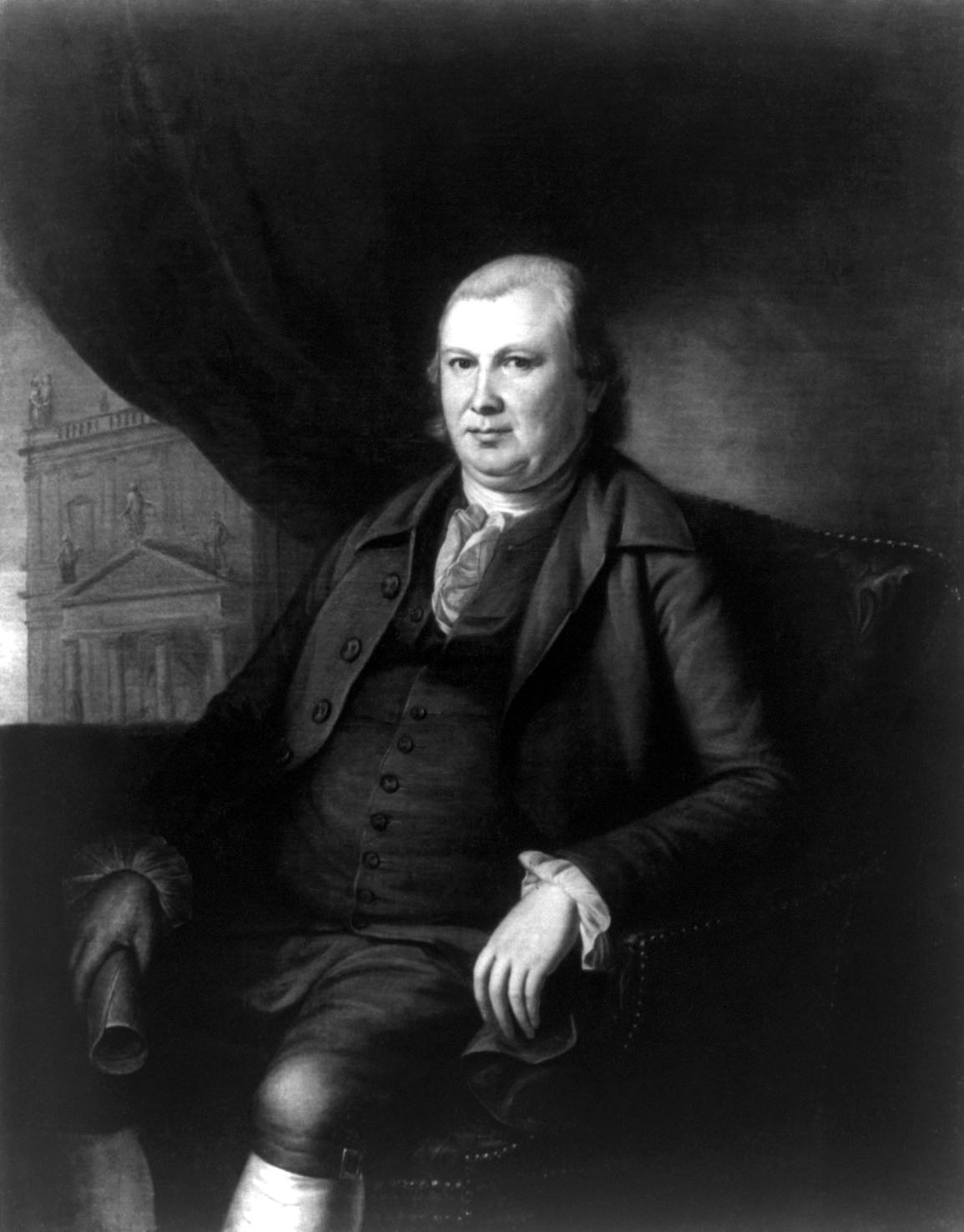
| Robert Morris January 20, 1734 – May 8, 1806 Was a Liverpool-born American merchant, and signer of the Declaration of Independence, the Articles of Confederation, and the United States Constitution. He was elected to the Pennsylvania Assembly, became the Chairman of the Pennsylvania Committee of Safety, and was chosen as a delegate to the Second Continental Congress, where he served as chairman of the "Secret Committee of Trade" and as a member of the Committee of Correspondence. He was one of Pennsylvania's original pair of US senators, serving from 1789 to 1795. Unwise land speculation right before the Panic of 1796–1797 led to his bankruptcy in 1798, and he spent several years in debtors' prison. After his release in 1801 he lived a quiet, private life in a modest home in Philadelphia, until 1806 when he died. |

| Thomas Nast September 27, 1840 – December 7, 1902 Was a German-born American caricaturist and editorial cartoonist who is considered to be the "Father of the American Cartoon". He was the scourge of Boss Tweed and the Tammany Hall political machine. Among his notable works were the creation of the modern version of Santa Claus and the political symbol of the elephant for the Republican Party. Contrary to popular belief, Nast did not create Uncle Sam (the male personification of the American people), Columbia (the female personification of American values), or the Democratic donkey, though he did popularize these symbols through his art. |