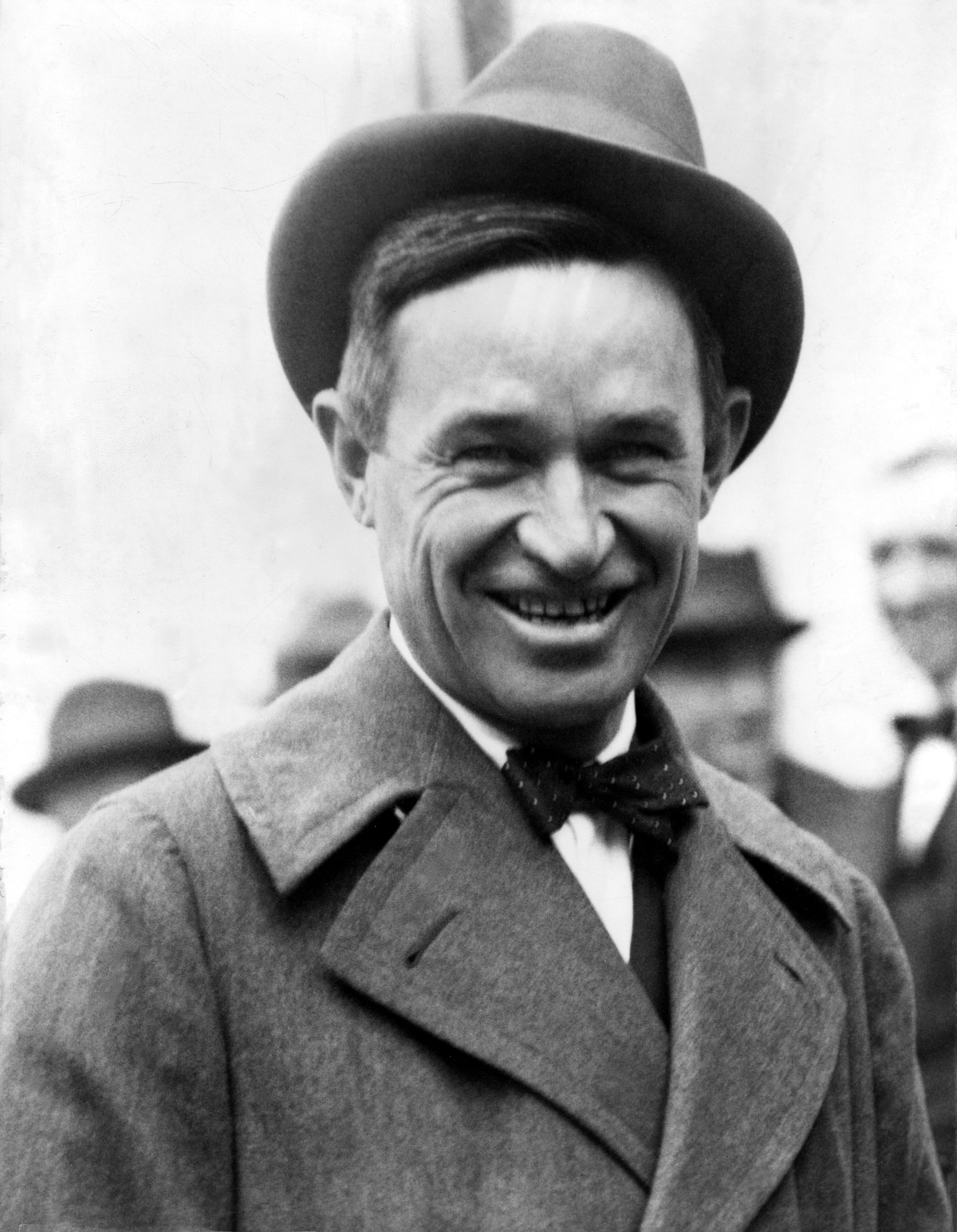
| Will Rogers November 4, 1879 – August 15, 1935 Was an American cowboy, vaudeville performer, humorist, social commentator and motion picture actor. He was one of the world's best-known celebrities in the 1920s and 1930s. Known as "Oklahoma's Favorite Son," Rogers was born to a prominent Cherokee Nation family in Indian Territory (now part of Oklahoma). He traveled around the world three times, made 71 movies (50 silent films and 21 "talkies"), wrote more than 4,000 nationally-syndicated newspaper columns, and became a world-famous figure. By the mid-1930s, Rogers was adored by the American people. He was the leading political wit of the Progressive Era, and was the top-paid Hollywood movie star at the time. Rogers died in 1935 with aviator Wiley Post, when their small airplane crashed in Alaska. |


| John Wesley Powell March 24, 1834 – September 23, 1902 Was a U.S. soldier, geologist, explorer of the American West, professor at Illinois State University, and director of major scientific and cultural institutions. He is famous for the 1869 Powell Geographic Expedition, a three-month river trip down the Green and Colorado rivers that included the first known passage through the Grand Canyon. Despite the loss of an arm in the Civil War, from 1867 Powell led a series of expeditions into the Rocky Mountains and around the Green and Colorado rivers. In 1869 he set out to explore the Colorado river and the Grand Canyon. Gathering nine men, four boats and food for 10 months, he set out from Green River, Wyoming on May 24. Passing through dangerous rapids, the group passed down the Green River to its confluence with the Colorado River (then also known as the Grand River upriver from the junction), near present-day Moab, Utah and completed the journey on August 13, 1869. |
| Joseph Pulitzer April 10, 1847 – October 29, 1911 Was a Hungarian-American newspaper publisher of the St. Louis Post Dispatch and the New York World. Pulitzer introduced the techniques of "new journalism" to the newspapers he acquired in the 1880s. He became a leading national figure in the Democratic Party and was elected Congressman from New York. He crusaded against big business and corruption. Today, he is best known for the Pulitzer Prizes, which were established by money he bequeathed to Columbia University, as was the Columbia School of Journalism. The prizes are given annually to award achievements in journalism and photography, as well as literature and history, poetry, music and drama. |
| FAMOUS & INFAMOUS AMERICANS |

| ABOUT THESE PHOTOS: These Photos Have Been Restored to Their Original Brillance by the SteelCactus Foundation. |

Photo Antiquities Museum of Pittsburg
| 531 East Ohio Street Pittsburgh, PA 15212 (412) 231-7881 |
| THE ONLY MUSEUM LIKE IT IN THE U.S.! |
See photos like this in their original form!
Plus the largest collection of cameras anywhere!
Plus the largest collection of cameras anywhere!


| Paul Revere December 21, 1734 – May 10, 1818 Was an American silversmith, early industrialist, and a patriot in the American Revolution. He is most famous for alerting Colonial militia of approaching British forces before the battles of Lexington and Concord, as dramatized in Henry Wadsworth Longfellow's poem, "Paul Revere's Ride." Revere was a prosperous and prominent Boston silversmith, who helped organize an intelligence and alarm system to keep watch on the British military. Revere later served as a Massachusetts militia officer, though his service culminated after the Penobscot Expedition, one of the most disastrous campaigns of the American Revolutionary War, for which he was absolved of blame. Following the war, Revere returned to his silversmith trade and used the profits from his expanding business to finance his work in iron casting, bronze bell and cannon casting, and the forging of copper bolts and spikes. Finally in 1800 he became the first American to successfully roll copper into sheets for use as sheathing on naval vessels. |
| Norman Rockwell February 3, 1894 – November 8, 1978 Was a 20th-century American painter and illustrator. His works enjoy a broad popular appeal in the United States for their reflection of American culture. Rockwell is most famous for the cover illustrations of everyday life scenarios he created for The Saturday Evening Post magazine for more than four decades. Among the best-known of Rockwell's works are the Willie Gillis series, Rosie the Riveter, Saying Grace (1951), The Problem We All Live With, and the Four Freedoms series. He is also noted for his work for the Boy Scouts of America (BSA); producing covers for their publication Boys' Life, calendars, and other illustrations. |
